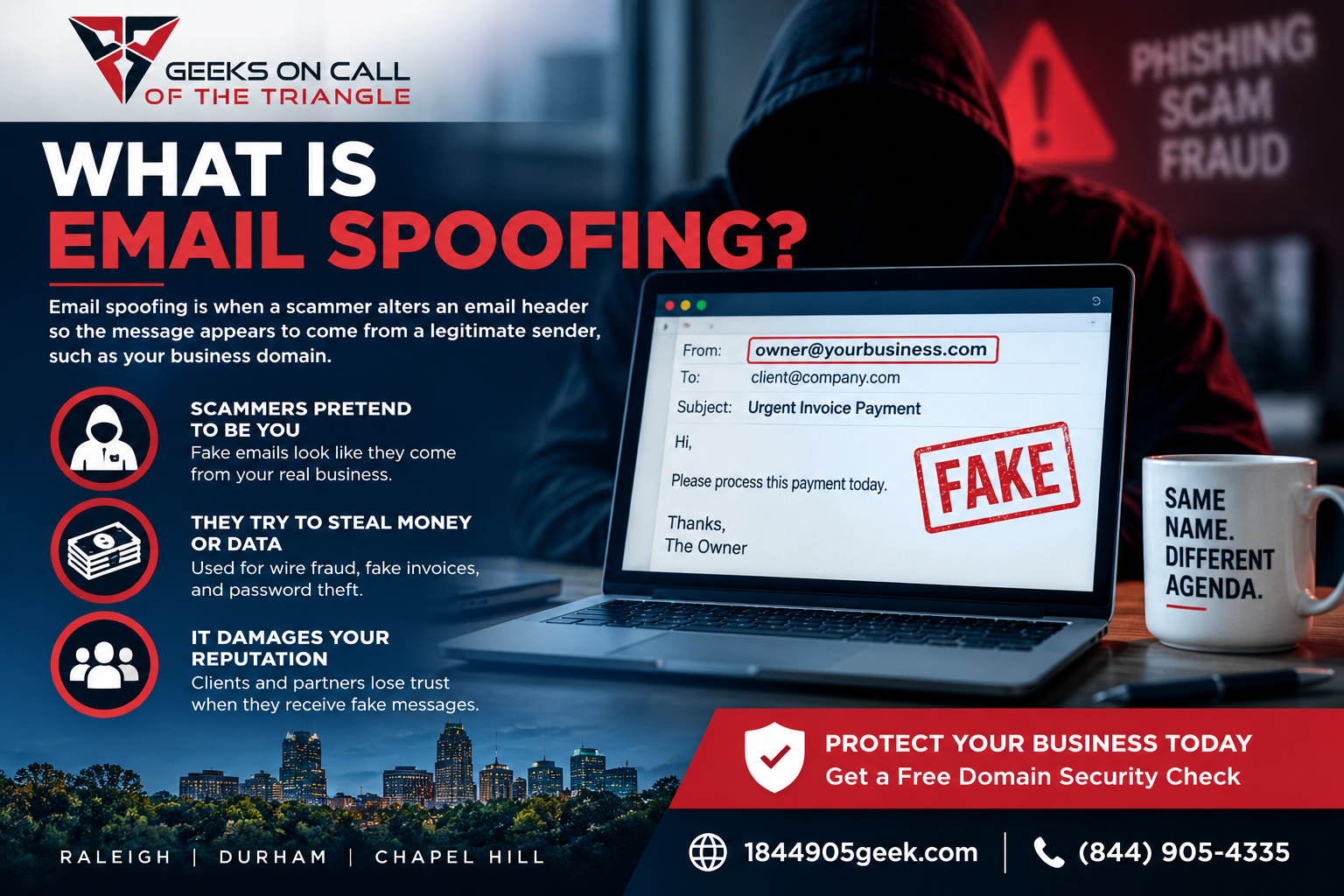
Email spoofing is a trick where a scammer alters an email header so the message appears to come from a legitimate sender, such as your own business domain. It is the digital equivalent of someone writing your return address on a piece of junk mail to trick the recipient into opening it. Scammers use this tactic to steal money, harvest passwords, or destroy a company's professional reputation by sending out thousands of fake messages under a real company name.
If you are currently dealing with this issue, you are likely feeling incredibly frustrated and stressed. It is an unsettling violation to see your business identity hijacked, especially when angry replies start flooding your inbox from strangers demanding to know why you sent them spam. You have not done anything wrong, and your computer network has not necessarily been hacked. Instead, scammers are simply exploiting a massive, fundamental loophole in the way the global email system was originally built.
When electronic mail was invented decades ago, security was not the primary concern, meaning anyone could type any name into the "From" line without verification. To fix this vulnerability, modern security experts developed a technical handshake method known as DMARC. This is a digital verification tool that tells receiving mail servers exactly how to check your identity and instructs them to block or junk any messages that fail the test. Think of it as a strict security guard at the gate who checks every incoming delivery against an authorized guest list and turns away anyone who is carrying a forged ID card.
For business owners here in Raleigh, Durham, and Chapel Hill, this problem has become a frequent headache that disrupts daily operations. When a scammer targets a local business in the Research Triangle Park area, they are usually looking for a quick payout by pretending to be the owner asking an employee for a wire transfer, or pretending to be a vendor sending a fake invoice to a client. Because the email looks exactly like a real message from your office, people trust it, click the links, and accidentally compromise sensitive data.
The consequences of ignoring this issue can quickly ripple through your entire organization. First, it destroys the trust you have spent years building with your clients, who may become hesitant to open any message you send. Second, when major providers like Google and Yahoo notice that your business domain name is tied to thousands of spam messages, they will start automatically blocking your real, everyday emails. Suddenly, your legitimate sales proposals, customer invoices, and regular employee messages start landing straight in the spam folder, paralyzing your communication.
Stopping this cycle requires shifting from a reactive mindset to a proactive stance. Many office managers make the mistake of changing all their passwords or running antivirus scans, which is a good practice but will not solve this specific dilemma because the fakes are not originating from inside your building. The ultimate solution lies in correctly configuring your domain identity settings behind the scenes so the internet knows exactly who is authorized to speak for you. Once those protections are locked into place, the global email ecosystem will automatically reject the impostors, restoring your good name and ensuring your real messages get delivered safely.
If you want to know if your company domain is currently vulnerable to being copied by scammers, you can get a free domain check at https://www.1844905geek.com/free-domain-security-scanner/ or book a free five minute call at https://www.1844905geek.com/contact-us/.
Elmer Hill, PMP
CEO and President
Geeks on Call of the Triangle